Instead of digging trenches, we should look for what unites us, says Dr. Oprala on the state of public debate in Slovakia
Cultivated dialogue is more necessary today than ever before. In an interview, an FMK UCM teacher pointed out the key aspects of free and decent discussion and explained how students are educated in this area.
At a time when social debates are increasingly being replaced by emotional exchanges of views on social media or in political programs, the ability to argue objectively and critically is becoming one of the most important skills, and not only for young people.
The Day of the Fight for Freedom and Democracy is also International Students' Day. At the Faculty of Mass Media Communication at UCM in Trnava, we believe that healthy communication can bring society together. That is why, on November 17, we commemorate the importance of education, critical thinking, and fair and decent argumentation.
We discussed the state of public debate in Slovakia and the need for education in this area with Dr. Branislav Oprala. Together with Dr. Michal Kabát, he teaches a course on argumentation. Although it was originally unofficial and did not offer credits, due to high student interest, it has been a full-fledged elective course at FMK for the second year now. Currently, 26 people from various fields of study at FMK are enrolled in the course.

What is the current state of the culture of dialogue in Slovakia?
In my opinion, it is currently in the worst state in Slovakia's modern history. Social media plays a large part in this, as it traps people in opinion bubbles, thereby significantly polarizing society. Disinformation media also play a role, and unfortunately, the level of political debate in Slovakia does not help either—it is often emotional, aggressive, and populist. It lacks decency, objectivity, and the ability to listen to each other.
You teach students something that would also be useful for many "adults" – the ability to argue in a civilized manner. In the current state of public debate, how can we encourage young people to strive for this?
As a society, we can do a lot by supporting education. Although it is often said that the quality of education in Slovakia is not ideal, we should strive to ensure that as many young people as possible obtain a university education, whether at home or abroad.
University is not just about professional training, but also about cultivating the individual. The more educated and critically thinking people there are in society, the better the culture of dialogue will be – both in real life and on social media.


How can we specifically motivate them to want to learn how to argue and discuss?
I think that the very fact that they are studying at the Faculty of Mass Media Communication should be a motivation in itself. Public speaking, cultivated and factual discussion, and correct argumentation should be the basic skills of FMK graduates.
Another motivating factor is that many students perceive polarization even within their own families—they see their relatives arguing, emotions prevailing over facts. This is a strong incentive for them to learn to communicate differently.
What other mistakes, apart from excessive emotionality, do people most often make when arguing?
The most fundamental error in argumentation is trying to convince others that their opinion is wrong. If we enter into a discussion with the aim of "winning," we will achieve nothing—we will only provoke an argument. An academic and civilized debate should be about presenting one's point of view based on facts.
Another key task is to listen to the other side and take their arguments into consideration. The basic principle is to let the other person finish speaking, not to interrupt them, and to try to find common ground from which to further develop the discussion. The ideal goal is to find some kind of consensus, but even agreeing that we cannot agree is a legitimate outcome.

November 17 is also associated with freedom of speech. How can we exercise this freedom in a way that contributes to dialogue rather than further polarization?
The most important thing is not to resort to extremes and refrain from trying to convince your opponent of your truth. We should try to argue objectively, respectfully, concisely, and with the aim of understanding. Today's society is divided into many camps—political, ideological, cultural—but instead of digging trenches, we should look for what unites us and build on that.
Some media outlets are capable of conducting civilized discussions, even though they hold different, for example, conservative values, and even though they disagree on all issues. This is the path we should take.
What is the role of young people, students, in bringing people together rather than dividing them?
Their task is to learn to debate first with themselves and then with those around them. They should be a generation that does not repeat the mistakes of their parents and grandparents—that is, they should not contribute to further polarization.
I believe that what they learn in my class can be put into practice—whether at home, when they see arguments about social issues, or later in the media, where they will work. These are so-called soft skills – skills that can contribute to a more civilized public debate and which they can later apply in media practice. During their professional careers, they will work in radio, television, and print media, for example, where they will cultivate communication in the media and thus also public debate.


What do the argumentation practice classes look like?
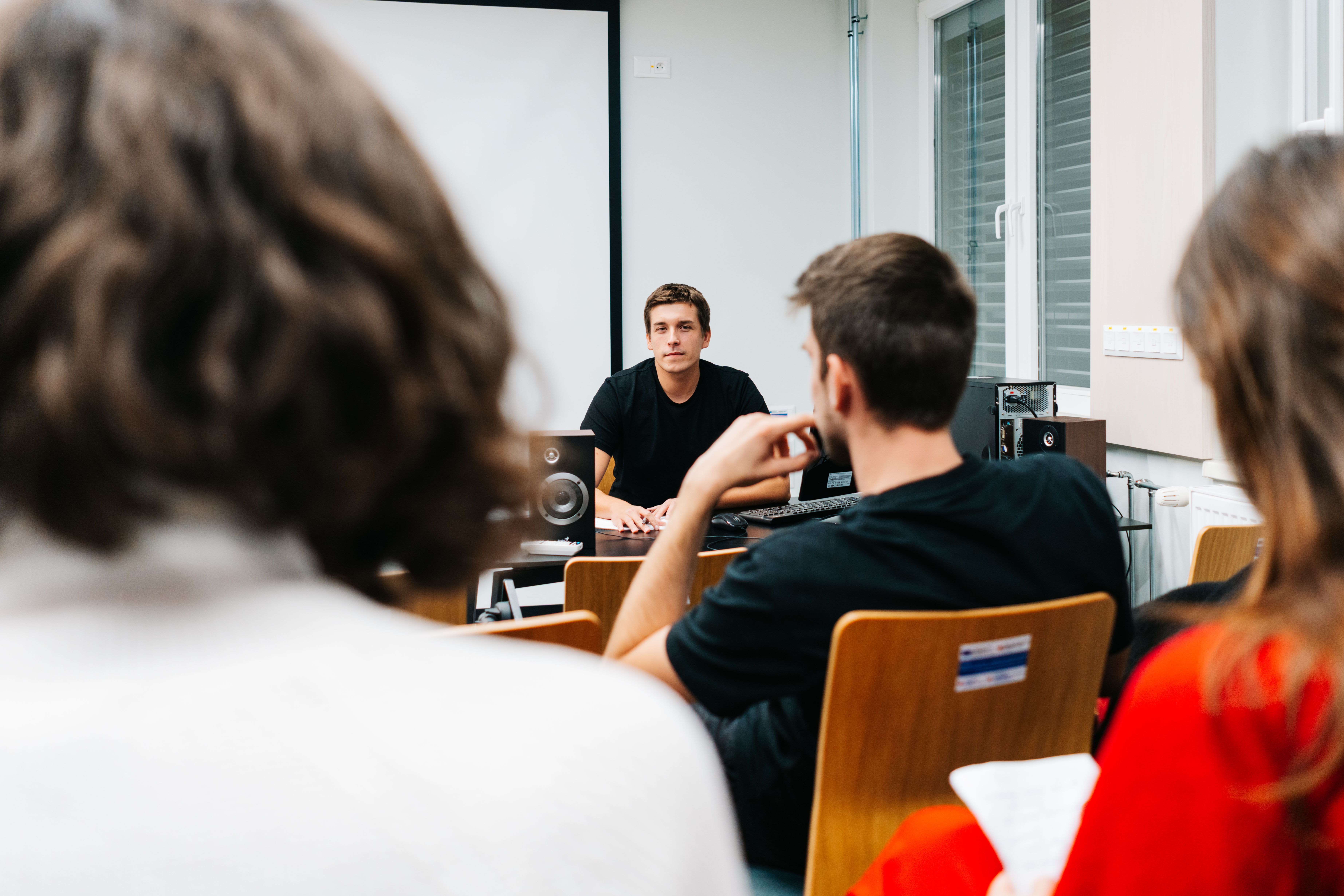
At the beginning, students have a short theoretical part where they learn about the principles of academic debate, the most common argumentative fallacies, and the roles of speakers. They are then divided into two teams—one defending and the other opposing a given thesis—and engage in debate. It is therefore a very practically oriented subject. Students learn to respond directly in discussion, build arguments, and listen to their opponents.
How are they dealing with it?
This academic year is still short, but after the first lesson I was really pleasantly surprised. They quickly understood the principles of argumentation and how to construct arguments. I am convinced that by the end of the academic year they will be debating really well.
Do you have a favorite moment from class?
I am very happy to see how students improve from lesson to lesson. The best feedback comes at the end of the semester, when many say that it was one of the most beneficial courses for them—that they learned something they had been missing.



Are you considering making this subject a compulsory course in the future?
I would like to, but in practice it would be difficult to implement. Academic debate is time-consuming—every student needs space to speak. If the subject were compulsory, dozens of teachers would have to teach it.
My goal is therefore to create a debate club that would operate outside of compulsory subjects – as a leisure activity. Students would meet regularly and improve their debating skills. Such clubs operate at many universities abroad and even organize inter-university competitions. This is something we would like to achieve here as well.
Source of photos: Magdaléna Tomalová



Mohlo by vás tiež zaujímať: